Initially funded by NIGMS supplement GM008336-33S1 in 2021–2022, Faculty Forum is a mentorship-focused continuing education program for faculty trainers in three NIH-funded training programs (T32GM152310, T32GM008336, T32AI007025, T34GM141971). This project creates institutional safety and enhanced wellbeing through trainee-centered discussions of mentoring.
Objectives
- Deliver mentorship training to faculty mentors to enhance the inclusion, safety, and training performances of our trainees.
- Use structures that build connections between faculty participants that lead to informal peer mentoring, scientific collaboration, and faculty inclusion.
- Model the value of mentorship training and help disseminate “Entering Mentoring” and Faculty Forum pedagogy and principles throughout WSU.
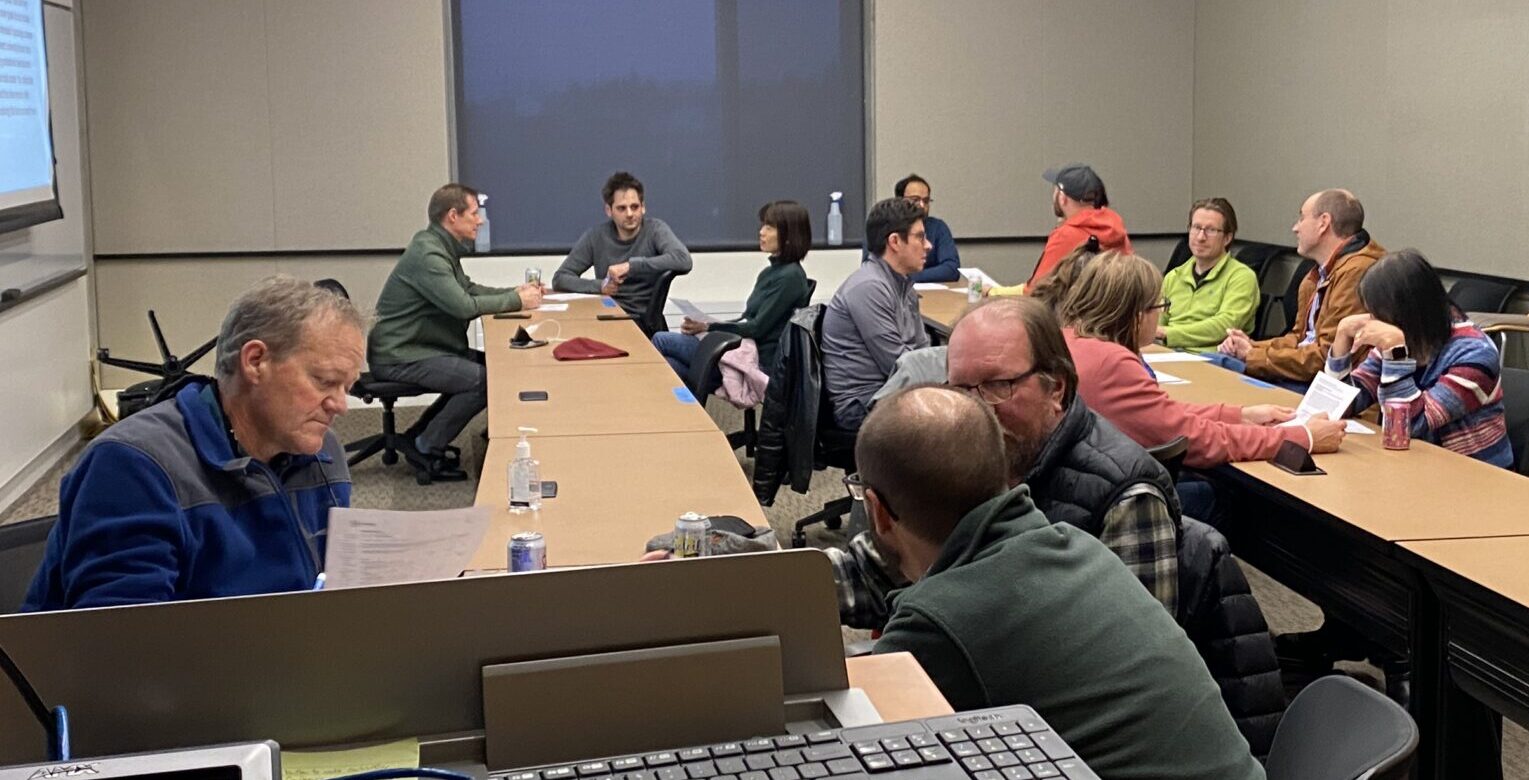
How is Faculty Forum structured?
Faculty Forum meets four-six times a year as a continuing education program to explore mentorship. Filling a niche in faculty training opportunities at WSU, our distinct facilitation draws upon research-proven “Entering Mentoring” curriculum created by the Center for Improvements in Mentored Experiences in Research (CIMER). Leaning on facilitation training from CIMER our facilitator uses 5E learning cycles that explore “Entering Mentoring” competencies with elaborations tailored to local training needs.
Example Session
Faculty Forum #6, which investigated “Promoting Professional Development,” is a good example of our typical facilitation. The link includes some slides and the faculty handout:
To engage the session, we explored local mentorship climate evaluation data in larger groups (up to 15 trainers). Then, faculty were shuffled into small groups to explore and explain a CIMER case study and investigate the AAAS myIDP individualized development plan tool. The elaboration of the myIDP tool was chosen to target a need raised by our local evaluation data. Finally, faculty returned to large groups to evaluate the myIDP tool and share suggestions for preparing mentees to use it.
Impact of the Faculty Forum project
- We have created and delivered seven (and counting) trainings to 55 faculty participants, with 27% of Fall 2023 participants not from our Biotechnology training program
- In our initial evaluation (after initial three meetings, so no long-term data yet) relatively less experienced faculty (five or fewer graduate students trained) reported gains in mentoring practice (100%) and connectivity with fellow faculty (100%), while relatively more experienced faculty reported gains in mentorship (80%) and connectivity with fellow faculty (93%).
- Principles from our facilitations have transferred to graduate RCR training, institutional DEI work, and local and national meetings involving our faculty participants.
- We are excited to monitor the program over the long haul to look for impacts on student inclusion, safety, mentorship support, and training outcomes.
Dissemination to other WSU mentor trainings
Our core “faculty forum” is tailored and delivered to our T32 and T34 program mentors. The following is a list of additional facilitations we’ve delivered at WSU:
- BioRISE, an NSF-funded RaMP for indigenous post bac trainees run by WSU and the University of Idaho
- Cases used for BioRISE 2024 facilitation
- Mentoring tools for use with Mentees, BioRISE 2024
- PDF of slides, BioRISE 2024
- Mentor training for assistant professors in the College of Engineering
- Summer mentoring workshop for intermediate research mentors
- We have also used “Entering Mentoring” cases in graduate-level responsible conduct of research lesson on inclusive mentoring that promotes wellbeing
Interested in more information or advice on your facilitation?
Our lead facilitator is program coordinator Matt Peck. In designing our implementation, we explored several facets of design (e.g., one-time training vs. continuing education needs; in-person vs. online; homogeneous vs. heterogenous participant groups) that impacted our evolved structures. Not every implementation has to look the same to have an amazing impact.