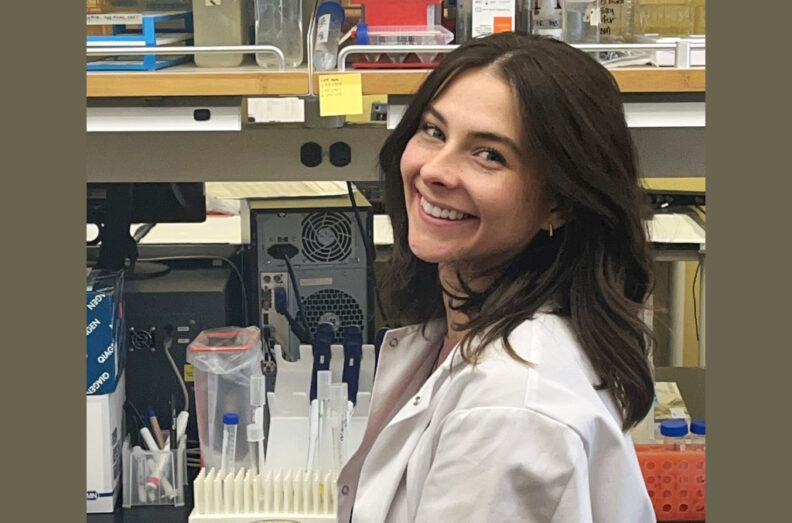
Having recently completed her doctorate in immunology and infectious diseases at Washington State University, Shannon Allen Whiles is excited to transition into her new role as a postdoctoral fellow in the Hsu lab at Virginia Tech.
In her new role, Whiles will develop bacteriophage technology to reprogram the gut microbiota to treat inflammatory bowel disease (IBD).
“I’m excited about the opportunity to translate cutting-edge research into real-world therapies. The chance to move technology from the lab into a potential startup that could eventually bring them to patients really excites me,” Whiles said.
While at WSU and under the mentorship of Dr. Tom Kawula, director of the Paul G. Allen School for Global Health and an infectious disease microbiologist, Whiles’s research focused on a highly infectious bacterium, Francisella tularensis, that can cause severe illness and even death. In addition to her work in the lab, Whiles was a trainee in WSU’s prestigious National Institutes of Health Protein Biotechnology Training Program, which offers doctoral students unique training, networking and leadership opportunities while preparing them for research and research-related careers, particularly in protein research and the creation of biotechnology.
Each trainee in the program is required to complete an 8- to 12-week-long internship with a biotechnology company. Trainees are frequently offered permanent positions at the conclusion of their internship.
Whiles completed her internship in South Carolina with Zylö Therapeutics, a biotech startup which specializes in drug delivery systems. Her experience in this internship gave her a firsthand look at the transition of academic research into industry, including key aspects of starting a company, like grant writing and the practical challenges involved.
While graduate programs tend to skew toward readying students for careers in academia, the NIH Protein Biotechnology Training Program – of which she served stints in its leadership as secretary and president – has a focus on preparing, training, and networking for careers in industry.
“I’ve heard that making the switch to industry can be challenging, especially for those who have spent their entire training focused on academic research,” Whiles said. “This program provided valuable exposure and training opportunities, equipping trainees with the experience and skills needed to succeed in diverse professional environments.”
The program includes faculty and trainees from the College of Veterinary Medicine’s Department of Veterinary Microbiology and Pathology, the School of Molecular Biosciences, and the Paul G. Allen School for Global Health; in addition to Voiland School of Chemical Engineering and Bioengineering; the Molecular Plant Sciences program; and the Department of Chemistry in the College of Arts and Sciences.
Trainees are encouraged to connect and collaborate with peers and faculty campuswide. In addition, students also have opportunities to network with industry leaders through various organized professional development meetings and the program’s annual symposium.
“I’m so grateful I was able to be involved in this program,” Whiles said. “I made many connections and learned a lot from training opportunities that would not been available to me otherwise.”
While at WSU, Whiles also received a fellowship from the ARCS Foundation, which provides financial awards and other opportunities to academically outstanding students who are studying to complete degrees in science, engineering, math, technology, and medical research. In addition, she participated as a mentor in the College of Veterinary Medicine’s Peer Mentoring Program, which pairs graduate students early in their studies with mentors who have already been in their shoes.
“The mentor program didn’t exist when I was a first-year, and I really wish it had because I would have really benefited from having an experienced grad student talk me through choosing rotations, a lab, a dissertation project, and so on,” Whiles said. “All of these programs really prepare students for success during and after their studies.”